

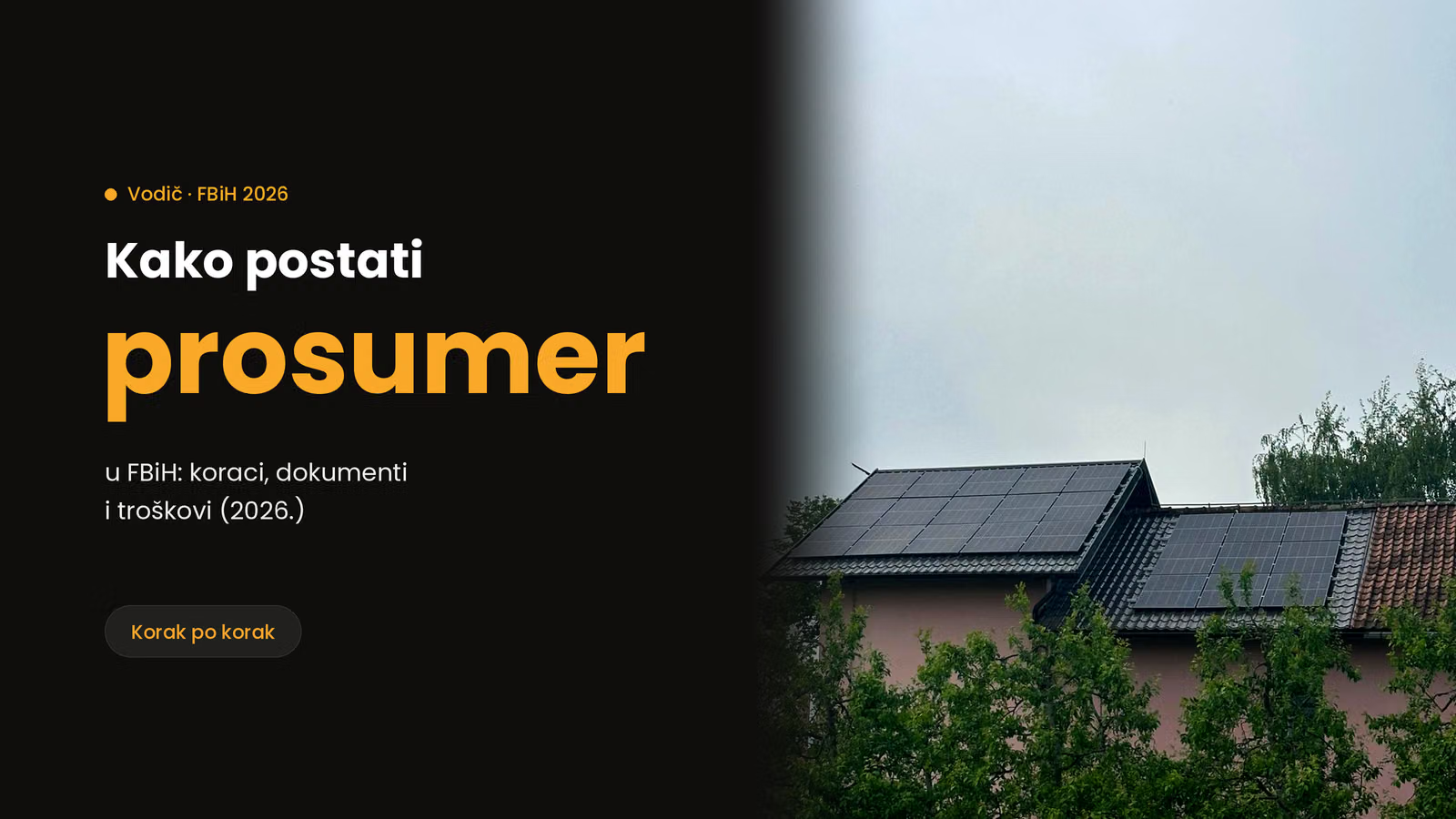
How to Become a Prosumer in FBiH: Step by Step (2026)
Updated: 21 Nov 2026 · E. Bošnjaković, electrical engineer
In brief: A household in the Federation of BiH becomes a prosumer in five steps. The first is the solar power plant project design, and based on it, an application for the energy consent (EES) is submitted to the distribution system operator. This is followed by registering works with the inspectorate, construction, and finally two contracts: the connection agreement with the distribution system operator and the supply contract with net metering with the supplier. A roof-mounted power plant smaller than 50 kW does not require a building permit. Up to 10,8 kW, surplus electricity is calculated through net metering for the first 10 years, kilowatt for kilowatt. The guide applies to the Federation of BiH, where power plants are connected by EP BiH and EP HZHB; different regulations apply in Republika Srpska.
What is a prosumer and who can become one?
A prosumer, or consumer-generator, is an electricity customer who produces electrical energy from the sun at their facility. They consume a portion immediately, while surplus is fed into the grid and used later. The Law on the Use of Renewable Energy Sources and Efficient Cogeneration („Sl. novine FBiH“, No. 82/2023) introduced this status in the Federation of BiH.
Any household with its own electricity meter and a roof or part of a plot for panels can become a prosumer. Buildings and residential complexes can also act collectively. Companies can also be prosumers, but net metering applies only to households.
This is still new ground. As of 31 January 2026, Elektroprivreda BiH had concluded contracts with only 30 prosumers. Therefore, the process seems more complicated to many than it actually is.
How to become a prosumer: steps from idea to connection
Assessment of consumption and roof. Take your electricity bills for the last 12 months. Power plant capacity is calculated from annual consumption. In Sarajevo, 1 kW of panels produces about 1.197 kWh annually (PVGIS), so 10 kW yields about 12.000 kWh.
Project design. The project design specifies the capacity, panel layout, inverter, protections, and the metering point. Without it, you cannot apply for the EES, and the public call for subsidies also requires it.
Application for energy consent (EES). The application is submitted to the competent distribution system operator (ODS), based on the project design. In the EES, the ODS establishes connection and metering conditions. Until the EES arrives, do not purchase equipment.
Certificate from the urban planning department and notification to the inspectorate. A rooftop power plant under 50 kW that does not exceed the roof boundaries requires neither a building permit nor urban planning consent. However, both power utilities in the Federation of BiH, EP BiH and EP HZHB, require a certificate from the municipal urban planning department stating that a building permit is not required for such a power plant in order to connect it. Before starting work, it is sufficient to register the commencement of works with the competent inspectorate, in accordance with cantonal regulations.
Construction and certification documentation. Panels, inverter, and protections are installed. Measurements and the certification and technical documentation required by the ODS for connection are carried out.
Connection and contracts. The prosumer concludes a connection agreement with the ODS and a supply contract with net metering with their supplier. The ODS installs a bi-directional meter, and the cost of adapting the metering point is borne by the prosumer. From that moment on, surplus electricity flows into the grid as a credit.
Important: the certificate stating that a building permit is not required is issued by the urban planning department only for legal and registered properties. If the house is not legalized or registered in the land registry, that process must be completed before applying for connection. Without the certificate, neither EP BiH nor EP HZHB will connect the power plant, even when it has already been built.
Who does what in the process?
Step | Who does it | What is obtained |
|---|---|---|
Project design | authorized designer | solar power plant project design |
Application for EES | investor or contractor on their behalf | energy consent from ODS |
Building permit certificate | municipal urban planning department | certificate that a building permit is not required (only legal and registered properties) |
Notification of works | investor | notification to the inspectorate on the start of works |
Construction | contractor | power plant, measurements, certification documentation |
Connection | ODS | bi-directional meter, connection agreement |
Supply contract | supplier (e.g. EP BiH) | supply contract with net metering |
Net metering or net billing: why is the 10,8 kW limit important?
Up to 10,8 kW of approved grid connection capacity of the power plant, a household uses net metering for the first 10 years. The surplus fed into the grid remains as a credit in kWh and is carried over to the next billing period. Each exported kilowatt is worth the same as one imported.
Above 10,8 kW, and after those 10 years, net billing applies. Then, the surplus is tracked as a monetary credit: the amount of exported energy × retail kWh price reduced by 10 %. For most houses, 10 kW is therefore the most cost-effective size, as it stays below the limit and takes full advantage of net metering. A detailed calculation can be found in the article Solar power plant 10 kW: price and profitability.
Even with net metering, grid fees are paid on all energy imported from the grid, about 0,097 KM/kWh with VAT. This is included in our savings calculations.
How much does it cost to become a prosumer and what support is available?
For a 10 kW power plant in Sarajevo, annual savings are around 2.162 KM, with a return on investment of about 5,1 years. With a subsidy from Operator za OIEiEK of around 6.594 KM, the payback period drops to about 2 years. We calculated using a price of 0,23 KM/kWh in the higher tariff (grid fees and VAT included), 45 % direct consumption, and 55 % surplus into the grid.
Cost or support | Amount | Note |
|---|---|---|
Project design (Enora) | 800 KM + VAT | 300 KM + VAT discount if you build the power plant with us |
Paket Plus 10, 10 kW, turnkey | 10.990 KM (metal sheet) / 11.990 KM (tile), with VAT | project design and paperwork included; not valid for USK |
Metering point adaptation | according to ODS price list | prosumer cost |
Operator za OIEiEK subsidy | according to the public call | consumption of 4.500 kWh annually; deadline 31.12.2026. |
GEFF loan | cashback up to 20 % | UniCredit, Intesa Sanpaolo, NLB, Mikrofin, EKI, Partner; payback shortens to about 4,1 years |
The subsidy from Operator za OIEiEK can be approved even before construction (everything about the call: Subsidies for solar panels in FBiH). The money is disbursed only when the plant is operational and the contract with the ODS is signed. In total, 4 million KM was allocated for the program, for about 500 power plants. Of that, 1,2 million KM is for vulnerable households. How the GEFF loan shortens the payback period was demonstrated in our article GEFF loan for solar power plants: cashback up to 20 %.
How Enora manages the entire process for you
When you build your power plant with us, you don't have to visit counters yourself. Enora d.o.o. from Sarajevo designs and builds solar power plants for prosumers and handles all paperwork for connection:
we produce the project design and, based on it, prepare the application for EES (the consent is issued by the ODS, not us);
we prepare the notification of works and documentation for the subsidy public call;
we install the power plant, carry out measurements, and prepare certification and technical documentation;
we lead the connection procedure up to the signed contracts.
Warranties: panels 30 years, on-grid inverters 5 years, hybrid inverters 10 years, installation works 5 years. Exactly what you get in the price is explained in our article Solar power plant 10 kW: what is included in the price. If you are choosing between a battery and a system without one, read Hybrid or on-grid solar power plant 10 kW.
Get in touch for an assessment: send us your electricity bill via WhatsApp to +387 67 129 6666 or +387 67 149 6666. We will reply with the capacity we recommend and how much you will save. Check out the Plus 10 package →
Frequently asked questions
Do I need a building permit for rooftop solar panels? No, if the power plant is on the roof, under 50 kW, and does not exceed the roof boundaries. For connection, both power utilities in the Federation of BiH (EP BiH and EP HZHB) require a certificate from the urban planning department stating that a permit is not needed, which is issued only for legal and registered properties. Before beginning work, works are reported to the competent inspectorate.
Who issues the energy consent? It is issued by the distribution system operator, i.e., the electricity distribution company competent for your area. The contractor can prepare and submit the application on your behalf, but they do not issue the consent.
Can I receive a subsidy if I am already building the power plant? The application for the Operator za OIEiEK subsidy can be approved before construction. Disbursement follows only once the power plant is operational and the contract with the ODS is signed. The call deadline is 31.12.2026.
What happens to surplus electricity in summer? Under net metering, the surplus becomes a credit in kWh and is carried over to the following billing periods. The summer surplus thus covers part of winter consumption.
What size power plant should I get? For a home with an annual consumption of about 12.000 kWh in Sarajevo, that is around 10 kW. At this capacity, you remain below the 10,8 kW limit and utilize full net metering.
Can I be a prosumer if I use electricity for heating? Yes, and that is usually when solar pays off the fastest, because consumption is high. The capacity should be calculated based on actual bills, not estimates.
Sources
Zakon o korištenju obnovljivih izvora energije i efikasne kogeneracije FBiH, Sl. novine 82/2023
FERK: Pravilnik o proizvodnji električne energije za vlastite potrebe (prosumera), izmjene 43/2025
Heinrich-Böll-Stiftung: Praktični vodič za građansku energiju u BiH
Operator za OIEiEK: javni poziv za sufinansiranje prosumera, oktobar 2026.
Odgovor na zastupničko pitanje o broju prosumera u EP BiH, 2026.