

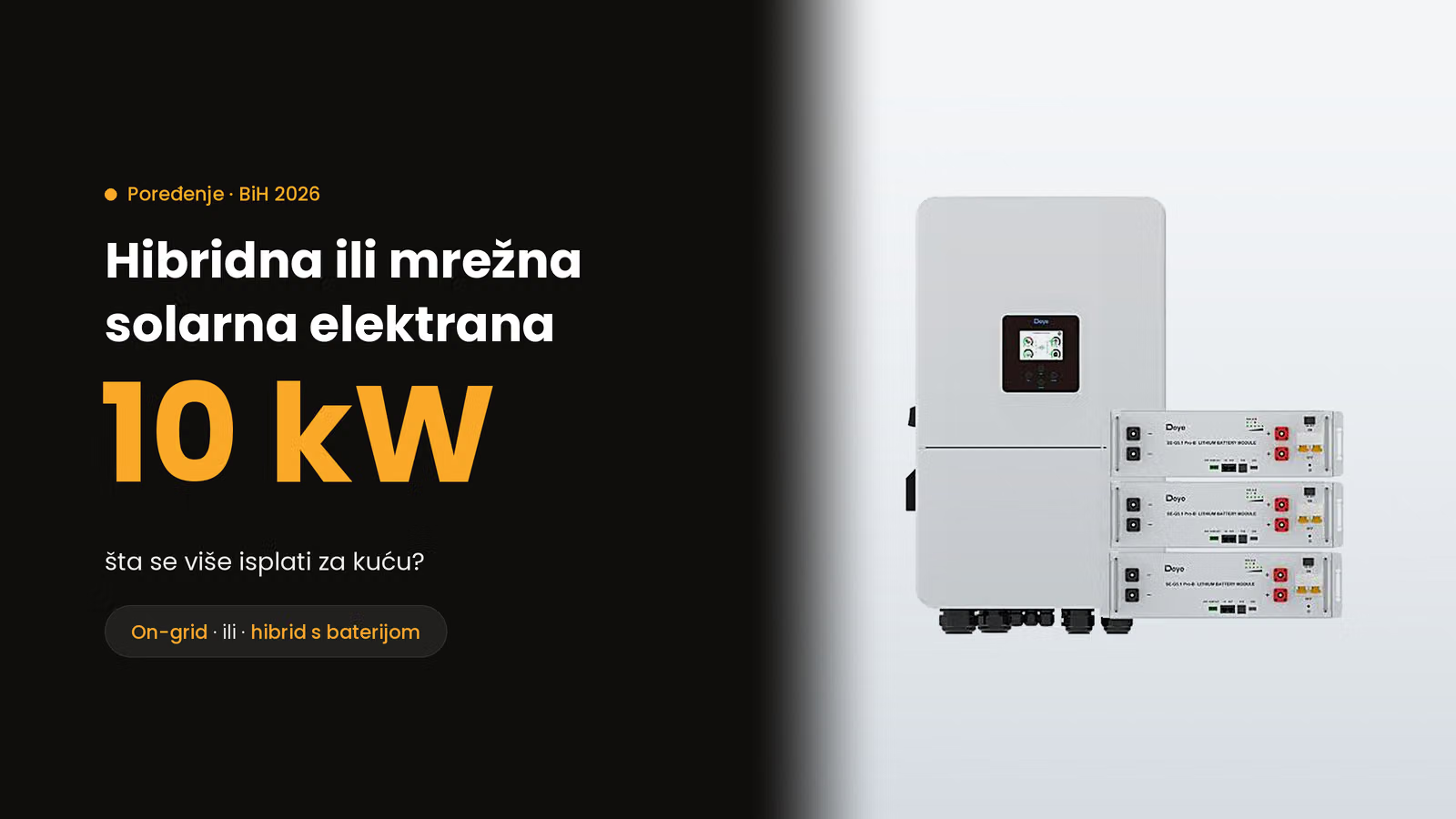
Hybrid or Grid-Tied Solar Power Plant 10 kW: What Is More Profitable for a Home?
Author: E. Bošnjaković, Electrical Engineer, Enora d.o.o. · Updated: November 16, 2026
Short answer: grid-tied solar power plant of 10 kW is the most affordable and provides the fastest return on investment. A hybrid system feeds less electricity into the grid, saving more each year, comes with twice as long warranty on the inverter (10 years vs. 5), and works during power outages when paired with a battery. For a house that consumes about 12,000 kWh annually, the grid-tied system in our example saves about 2,170 KM, the hybrid without a battery about 2,340 KM, and the hybrid with a 10 kWh battery about 2,515 KM.
We get the "hybrid or grid-tied" question almost every day, usually right after "how much does it cost". The answer depends on how your house uses electricity, so we took one 10 kW solar plant, two Deye inverters of the same power rating, and ran them through the same year. The figures are below, along with all the assumptions.
What Is a Grid-Tied and What Is a Hybrid Solar Power Plant?
A grid-tied (on-grid) power plant converts sunlight into electricity and immediately sends it to the house. Whatever the house does not consume at that moment goes into the grid. It has no battery and does not work during a blackout, because for safety reasons the inverter shuts down as soon as it loses the grid connection.
A hybrid solar power plant does the same thing, but has two additional outputs: one to the battery and one backup output to the house. In addition, it balances power across phases, matching exactly what the house is consuming. If you install a battery, excess power charges it first, and only then goes into the grid. In the evening, the house draws from the battery, and when the grid goes down, the inverter continues to power your selected consumers.
The panels, mounting structure, and cables are the same in both cases. The difference lies in the inverter. With a hybrid system, the battery is optional: you can install it right away or add it later.
Two Inverters of the Same Power: Deye SG05LP3 and Deye G06
For comparison, we took two three-phase Deye 10 kW inverters: the hybrid SUN-10K-SG05LP3-EU-SM2 and the grid-tied SUN-10K-G06P3-EU-AM2. On paper they provide the same power, but deliver it to the house differently.
Hybrid: Deye SUN-10K-SG05LP3 | Grid-Tied: Deye SUN-10K-G06P3 | |
|---|---|---|
Rated output power | 10 kW | 10 kW |
Phase distribution | asymmetrical, up to 5 kW per phase (50% of rated power) | symmetrical, same power across all three phases |
Battery | 48 V, charge and discharge up to 210 A | no battery connection |
Operation during grid outages | yes, via backup output | no |
MPPT inputs | 2 | 2 |
Inverter warranty | 10 years | 5 years |
The grid-tied G06 excels at what it was designed for: its efficiency reaches up to 98.5%, and its job is to convert everything from the roof into electricity as quickly as possible. The hybrid SG05LP3 additionally decides where that electricity goes: to which phase, into the battery, or into the grid.
Asymmetrical Output: Why a Hybrid Inverter Keeps More Electricity in the House
Asymmetrical output means the inverter supplies each phase with as much power as that phase is consuming at that moment. The Deye SG05LP3 does this up to 5 kW per phase. A grid-tied inverter cannot do this: it always splits production into three equal parts.
A house never consumes power evenly. Water heaters, ovens, and washing machines are single-phase appliances and often run on the same phase, while the other two remain almost idle. And a bidirectional meter measures each phase separately: what you feed into the grid on one phase does not offset what you draw on another at the same time.
Consider a sunny midday where the solar plant produces 6 kW, and inside the house, the water heater and oven are running on the first phase:
Phase | House consumes | Grid-tied inverter delivers | Meter with grid-tied | Hybrid inverter delivers | Meter with hybrid |
|---|---|---|---|---|---|
L1 | 4.5 kW | 2.0 kW | draws 2.5 kW | 4.5 kW | 0 |
L2 | 0.5 kW | 2.0 kW | feeds 1.5 kW | 0.5 kW | 0 |
L3 | 0.3 kW | 2.0 kW | feeds 1.7 kW | 0.3 kW | 0 |
The house consumes 5.3 kW, the roof produces 6 kW. With a grid-tied inverter, you still draw 2.5 kW from the grid on one phase, while simultaneously feeding 3.2 kW into the grid on the other two. With a hybrid, you draw nothing from the grid. The actual surplus of 0.7 kW charges the battery, and if there is no battery, only this amount is fed into the grid.
That is why asymmetry is so important. A hybrid inverter does not produce a single kilowatt-hour more, but delivers it to the phase where it is consumed. Over a year, a grid-tied inverter simply feeds more energy into the grid than a hybrid, and draws just as much back out. This holds true even when the hybrid has no battery.
One Year on a House with a 10 kW Solar Power Plant
In one year, the grid-tied system in our example feeds 6,600 kWh into the grid, the hybrid without a battery 4,800 kWh, and the hybrid with a battery 3,000 kWh. Total production is the same in all three cases: 12,000 kWh.
Why does this matter if you are a prosumer on net metering, where a kilowatt-hour fed into the grid is returned as a kilowatt-hour? Because that return is not free. According to the prosumer billing explanation by Elektroprivreda BiH, network fees are charged on all electricity drawn from the grid, including what you previously fed in yourself.
Assumptions for the calculation:
10 kWp plant in Sarajevo, approximately 12,000 kWh annually (PVGIS, 1,197 kWh per kWp)
house with a three-phase connection and annual consumption of 12,000 kWh
electricity price of 0.234 KM/kWh at peak tariff, including network fees and VAT
network fee approximately 0.097 KM/kWh
hybrid power plant in two variants: without a battery and with a 10 kWh battery
Over one year | Grid-Tied (Deye G06) | Hybrid without battery (Deye SG05LP3) | Hybrid with 10 kWh battery (Deye SG05LP3) |
|---|---|---|---|
Production | 12,000 kWh | 12,000 kWh | 12,000 kWh |
Consumed directly in the house | 5,400 kWh (45%) | 7,200 kWh (60%) | 9,000 kWh (75%) |
Fed into the grid | 6,600 kWh | 4,800 kWh | 3,000 kWh |
Drawn from the grid | 6,600 kWh | 4,800 kWh | 3,000 kWh |
Network fees on drawn electricity | approx. 640 KM | approx. 465 KM | approx. 290 KM |
Bill without solar plant | 2,808 KM | 2,808 KM | 2,808 KM |
Annual savings | approx. 2,170 KM | approx. 2,340 KM | approx. 2,515 KM |
Self-consumption shares are estimates for a typical house, not an on-site measurement. Your numbers could be higher or lower depending on daytime usage patterns and how appliances are distributed across phases.
In this example, the hybrid without a battery saves about 170 KM more annually than the grid-tied system, and with a battery, about 345 KM more. There is another factor not shown in the table: energy credits are tracked separately for peak and off-peak tariffs, and unused credits are cleared on March 31. A kilowatt-hour that never went to the grid can never be lost.
Price Difference: How Much Does a 10 kW Hybrid vs. Grid-Tied Plant Cost
A 10 kW grid-tied solar plant starts with us from 10,990 KM, a hybrid without a battery from 13,990 KM, and a hybrid with a 10 kWh battery from 17,100 KM. All prices include VAT, installation, and commissioning. System design is always included in the package price.
Grid-Tied Plus 10 | Hybrid Plus 10 without battery | Hybrid Plus 10 with 10 kWh battery | |
|---|---|---|---|
Package price | from 10,990 KM (metal roof), from 11,990 KM (tile) | from 13,990 KM | from 17,100 KM |
Inverter warranty | 5 years | 10 years | 10 years |
Annual savings in our example | approx. 2,170 KM | approx. 2,340 KM | approx. 2,515 KM |
Payback period without subsidies | approx. 5.1 years | approx. 6.0 years | approx. 6.8 years |
OIEiEK subsidy | approx. 6,594 KM | 7,000 KM | 7,000 KM |
Payback with OIEiEK subsidy | approx. 2.0 years | approx. 3.0 years | approx. 4.0 years |
A hybrid without a battery is 3,000 KM more expensive than a grid-tied system. That difference comes from the more expensive inverter, phase metering, and distribution for backup power. A 10 kWh battery adds another 3,110 KM.
If you only look at payback years, the grid-tied system wins, and we won't sugarcoat it. But payback time is not the full picture. The grid-tied inverter goes out of warranty after the fifth year, whereas the hybrid is covered for a full ten years—long after the solar plant has paid for itself. The inverter is an electronic device working every single day, making its warranty more important than any other in the system.
A hybrid also saves more each year, and that advantage widens over time for two reasons:
Network fees. Every increase in network fees directly boosts the hybrid's advantage, because it runs 1,800 kWh less through the meter without a battery, or 3,600 kWh less with one. Elektroprivreda BiH has already announced an increase in network fees in its business plan.
Net billing. Under this scheme, a fed-in kilowatt-hour is worth the energy component minus 10%, meaning noticeably less than what you buy. Here, self-consumption determines the profitability of the entire power plant.
The OIEiEK Operator subsidy amounts to 50% of the reference construction cost, up to a maximum of 7,000 KM or 60% of invoice-proven costs, whichever is lower. For the Grid-Tied Plus 10, that is about 6,594 KM, and for both hybrid packages 7,000 KM. With the subsidy, even a hybrid system with a battery pays for itself in about four years, while the inverter warranty continues for about six more.
What Else You Get with a Hybrid Plant, and When Grid-Tied Is the Better Choice
In addition to higher self-consumption, a hybrid power plant brings three things that do not show up on the bill:
Twice as long warranty. We provide a 10-year warranty on the hybrid inverter, and 5 years on the grid-tied one.
Power during grid outages. With a battery, the refrigerator, boiler room, lighting, and internet keep running, and you will not even notice the switchover.
Room to grow. If you start without a battery, you can add it later without replacing the inverter. A heat pump or EV charger integrates much more smoothly when you already have per-phase control.
A grid-tied plant is the better choice in these cases:
the shortest possible return on investment is your main priority
you consume most of your electricity during the day because you work from home or run AC in summer
power outages are rare in your area and do not bother you
your budget is limited, and you can add a battery later as a separate system
Both systems are great choices when tailored to actual household consumption, which is why we start every proposal with your electricity bill.
Frequently Asked Questions About Hybrid and Grid-Tied Solar Power Plants
What is the difference between a hybrid and a grid-tied solar power plant?
A grid-tied plant immediately feeds electricity that the house does not consume into the grid and does not work during an outage. A hybrid stores surplus energy in a battery first, balances power across phases according to consumption, and keeps running when the grid fails.
What does asymmetrical output of a hybrid inverter mean?
It means the inverter delivers different amounts of power to each of the three phases, matching what each phase is drawing. The Deye SUN-10K-SG05LP3 can deliver up to 5 kW on a single phase. A grid-tied inverter always distributes power equally across all three phases, thus sending more energy into the grid throughout the year.
How much does a 10 kW hybrid solar power plant cost?
Hybrid Plus 10 starts from 13,990 KM without a battery and from 17,100 KM with a 10 kWh battery. Grid-Tied Plus 10 starts from 10,990 KM. Prices include VAT and installation, and the exact figure is confirmed after a roof inspection.
Does a hybrid solar power plant work during a blackout?
Yes, if it has a battery. The hybrid inverter then switches to backup power from the battery and solar panels. A grid-tied plant shuts down immediately, even when the sun is shining.
Is a battery worth it on net metering?
A 10 kWh battery costs 3,110 KM more and in our example saves about 175 KM per year compared to a hybrid without a battery. Based on network fees alone, payback is slow. It pays off for those who value backup power and greater independence from future price changes and billing regulations.
Can I upgrade a grid-tied plant with a battery later?
Yes, you can. The battery is added as a separate system alongside the existing grid-tied inverter. If you already know you want a battery, it is cheaper to choose the hybrid package without a battery upfront and add the battery when you are ready.
What is the warranty on a hybrid versus a grid-tied inverter?
The warranty on the hybrid inverter is 10 years, and 5 years on the grid-tied inverter. The panels come with a 30-year warranty in both packages.
Which Package Is Right for Your House?
Send us your electricity bill and within 24 hours you will receive an estimated capacity, price, and payback calculation for both systems, with no obligation.
Hybrid Plus 10 is for homes that want to consume as much of their own electricity as possible and maintain power during blackouts: 10 kW of panels and a Deye hybrid inverter with asymmetrical output and a 10-year warranty, from 13,990 KM without a battery or from 17,100 KM with a 10 kWh battery. Request a quote for Hybrid Plus 10
Grid-Tied Plus 10 is for those seeking the fastest return on investment: 10 kW of panels and a three-phase grid-tied inverter, from 10,990 KM with installation. Request a quote for Grid-Tied Plus 10
Not sure which one? Call or message via WhatsApp: 067 129 6666 or 067 149 6666. System design is included in the package price and prepared prior to installation, allowing you to make a decision based on your own figures.